


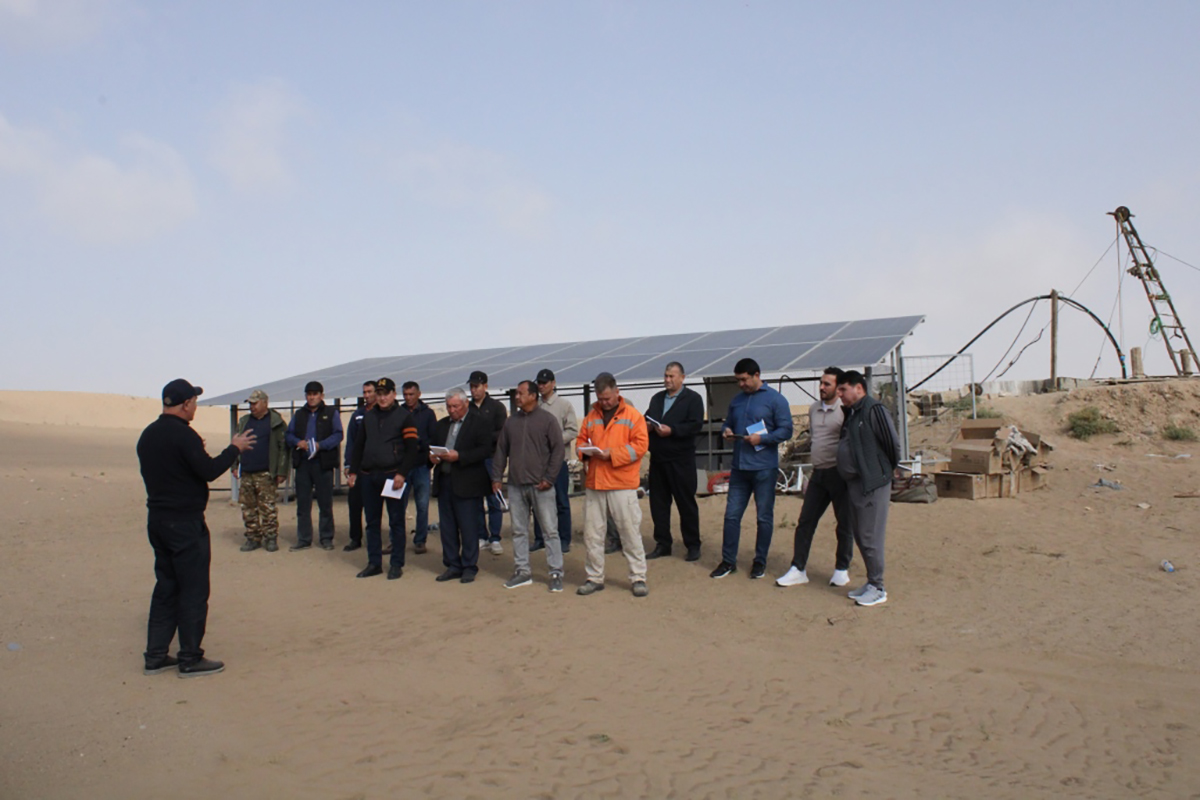
In the Murgab Oasis, a solar installation was commissioned that will supply electricity to a pump lifting water from a well over 150 meters deep. The renewable energy source was connected to the well on the site with the financial support of GIZ. The installation and adjustment of the equipment were carried out by specialists from the companies “Gerçek gala” and “Täze Energiýa”.
The opening of the innovative facility brought together representatives of the Ministry of Environmental Protection of Turkmenistan, the State Association of Livestock and Poultry Industry of the country, the construction and repair enterprise “Maryörisuw”, as well as managers, specialists, and shepherds from the oldest sheep-breeding farms - “Karakul” and “Maldar”, who will directly use the renewable energy system.
Future users of the innovation supported the introduction of energy-efficient solutions for sustainable transhumant livestock farming, emphasizing that the experience gained will serve as an incentive for other enterprises and agricultural producers to more widely apply practical measures for adapting agricultural production to climate change.
A practical seminar was held in conjunction with the event, aimed at improving the qualifications of farmers and specialists in sustainable water resource management under climate change conditions. The training focused on the principles of operation and efficient use of solar-powered water pumping systems for livestock needs in the conditions of the Garagum Desert.
The workshop will enable farmers to increase the efficiency of the equipment, prevent breakdowns, and extend the service life of the installation, which is intended to ensure uninterrupted water supply for grazing flocks. It was noted that introducing renewable energy technologies into the operations of isolated sheep- and camel-breeding farms is of great importance for sustainable pasture use. The watering of such areas will significantly reduce the consumption of traditional diesel fuel, lower operating costs, and lessen the negative impact on the environment.
The event was held as part of the implementation in Turkmenistan of the regional program of the German Society for International Cooperation (GIZ) — “Climate Risk Management in Central Asia.”