


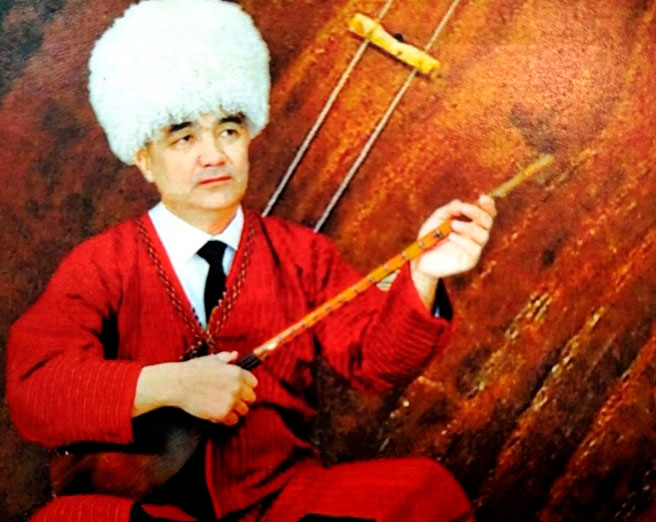
“The dutar is my destiny, my closest friend, to whom I can entrust my most intimate thoughts and feelings.” These words belong to Orazmyrat Annanepesov, People’s Artist of Turkmenistan, Associate Professor at the M. Kuliyeva Turkmen National Conservatory, and a renowned dutar player.
Today, these words sound like a testament. The musical art of our country has suffered an irreparable loss: at the age of sixty-eight, after a prolonged illness, the master’s heart ceased to beat.

An outstanding musician, a profound researcher, and a talented composer-mukamchi, Orazmyrat Annanepesov became for his contemporaries a symbol of selfless devotion to art. Listeners will remember him as a genius capable of conveying the entire spectrum of human emotions with a single touch of the strings.
A representative of the Ahal dutar school, he became a worthy successor to such classics as Chary Tachmamedov, Mylla Tachmyradov, and Purli Saryev. Yet his mission extended far beyond preserving tradition. The master believed that folk music is not a frozen monument of the past but a living participant in modern life. He created his own distinctive performing style, respectfully referred to by professionals as “Oraz Annanepesowyň çalyşy”. Today, his interpretations of ancient works are considered exemplary.
Oraz Annanepesov was a musician with a broad spirit and an open worldview. He proved that the Turkmen dutar is capable of any music: in his hands, the instrument acquired Russian, Hungarian, or Kazakh sonorities. This breadth of vision also formed the foundation of his unique pedagogical approach.

The master masterfully combined the ancient “mentor–disciple” system with academic study of musical notation. His artistry was universal: he performed solo folk pieces and complex compositions accompanied by a symphony orchestra with equal virtuosity, promoting the modern prima dutar.
The legacy of Orazmyrat Annanepesov is immense. He created dozens of original saz compositions and song-aydyms based on the poetry of classical and contemporary poets, including the monumental work “Dabaraly Mukam,” co-written with composer J. Kurbanklycheva. The musician produced more than fifty transcriptions of folk melodies and defended the country’s first Candidate of Sciences dissertation on the art of Ahal dutar performers, which became a foundational work in the study of the history and theory of folk instrumental performance in Turkmenistan.
Over the years of his teaching career, the master educated more than seventy students who today represent his school with dignity. Orazmyrat Annanepesov’s dutar resonated inspiringly in concert halls across Russia, Europe, and Asia. The master generously shared his talent, scholarly discoveries, and warmth of spirit. He often said that the sound of the strings echoed the subtlest movements of his soul, transforming the world around him.
The work of Orazmyrat Annanepesov became an entire era in the development of Turkmenistan’s national musical school. He departed for eternity too early, but left behind a legacy over which time has no power. The bright memory of the great master will forever remain in the hearts of the people and in every sound of his beloved dutar.