


At the mention of Koytendag, one envisions a corner of our country that captivates the imagination with its unique beauty and natural wonders. Vast plateaus bearing dinosaur footprints, remarkable mountain caves, gorges such as Daraydere, Tutlydere, Umbardere, and Kyrk Gyz, an underground lake inhabited by blind fish, a grove of jujube trees, the highest point of our country—the Ayrybaba Ridge—and much more are extraordinary gifts of nature that attract travelers not only from Turkmenistan but from all over the world.
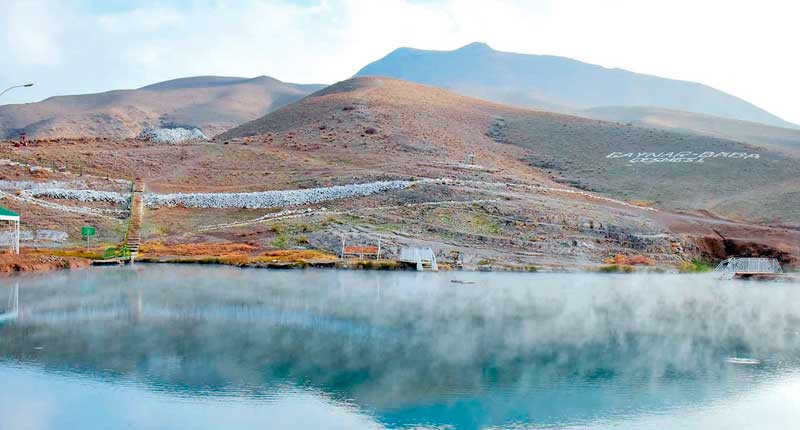
Another unique site of Koytendag is the mysterious “Hojagaynar” spring, known among local residents as “Gaynarbaba,” located south of the settlement of Garlyk and originating on the western slope of the mountain range. This spring, measuring 40 meters in length, nearly 30 meters in width, and reaching depths of about three meters in some places, is sometimes referred to as a lake. It is formed by the confluence of two different springs, and due to its healing properties, the local population reveres it as a sacred place. One of the springs is distinguished by its crystal clarity, while the other has a cloudy white color caused by a high concentration of hydrogen sulfide. Locally, they are called “ak suv” (white water) and “gok suv” (blue water). The name “Gaynarbaba” arose because the water seeping from the foot of the mountain appears to bubble or boil.
The National Leader of the Turkmen people, Hero-Arkadag, writes about this spring in his book “Turkmenistan – The Heart of the Great Silk Road”: “Scientific research conducted by scholars has confirmed its healing properties. The water that gushes from beneath the earth here bubbles and foams as if boiling. Perhaps this is why the place received the name ‘Gaynarbaba’ (‘boiling’).”
The renowned scholar Soltansha Ataniyazov, who conducted extensive research on the origins of toponyms, writes in his book “Toponymic Dictionary of Turkmenistan”: “Hojagaynar is a sulfur spring (also called ‘Gaynarbaba’) in the Koytendag district (formerly Charshanga, Garlyk). The word ‘hoja’ here means ‘sacred,’ similar to the words ‘ata’ and ‘baba.’ It frequently appears in the names of cemeteries, salt marshes, and sulfur springs (often added before the name), while the word ‘gaynar’ denotes springs where boiling water gushes forth.”
Using modern scientific methods, researchers have determined that the “Gaynarbaba” spring possesses healing properties. The presence of hydrogen sulfide, minerals, and other chemical elements in the spring water makes it suitable for treating various ailments, including skin diseases, mental disorders, and digestive system illnesses. One of its key features is the constant water temperature, which remains around 22°C throughout the year.
Another remarkable and curious feature of the spring is the presence of fish, despite the absence of any connection to rivers or other bodies of water. How could fish have appeared in a spring emerging from underground? Specialists from the scientific department of the Koytendag State Nature Reserve suggest that fish eggs may have been carried here by birds that permanently inhabit the area and migrate from across the country.
The fact that the fish living in the lake swim fearlessly alongside people also indicates that they have become accustomed to human presence. This is explained by the sacred status of the site and the prohibition of fishing there. Notably, no predatory fish species are found in the spring. In addition, mollusks, earthworms, and other invertebrates dating back to the Jurassic period are present here. For this reason, scientists refer to the spring as a true museum of living organisms.
Another unique feature is the presence of Melania—an endemic species of snail measuring 3–4 centimeters. These unusual white shells with speckled patterns are found nowhere else in the world except in this spring.
Like other remarkable sites of Koytendag, the “Gaynarbaba” spring remains subject to in-depth scientific study.