


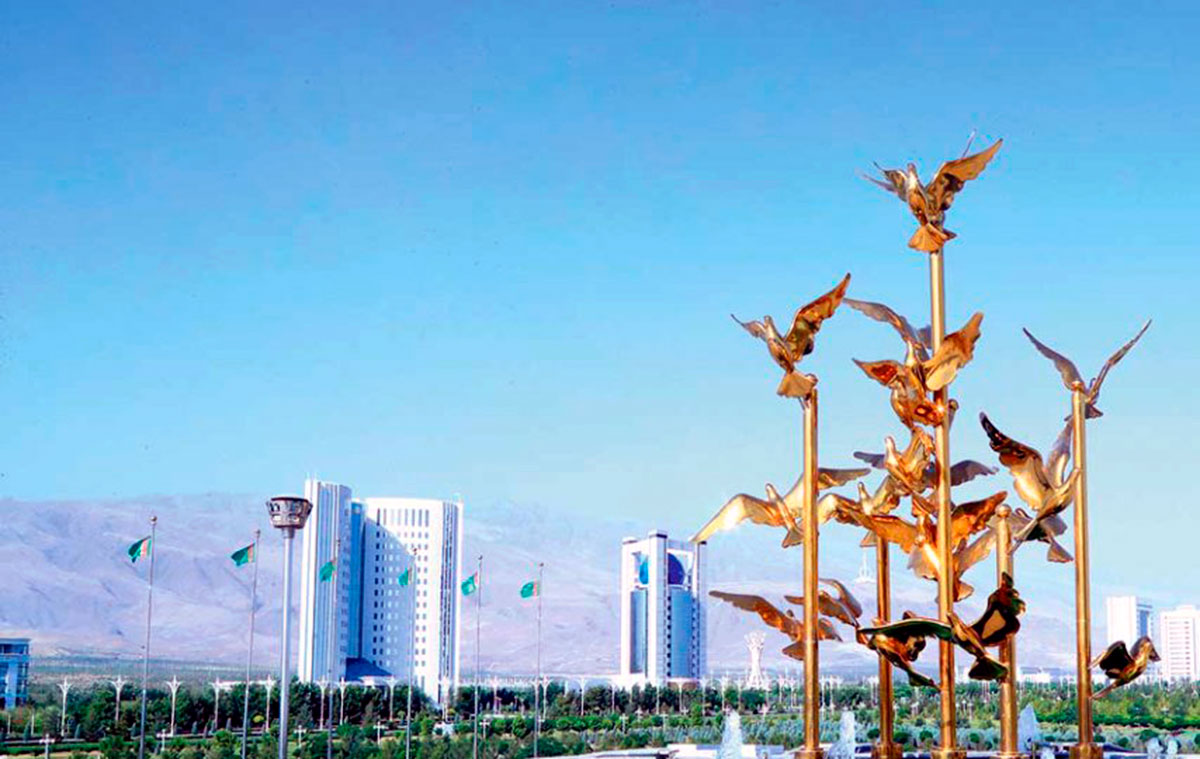
Peace is a comprehensive concept that embodies the highest values of humanity. In the modern understanding, peace is a common living space for billions of people of different ethnic origins who live on various continents, speak numerous languages and dialects, and are united by a shared culture — the culture of humanity. Throughout human history, great civilizations have emerged, powerful states have been established, and unique nations have developed. They have all been united by one common idea — ensuring peace as the foundation of sustainable development.
The worldview of the Turkmen people has always been rooted in the principles of humanism, harmoniously combining the ideals of peacebuilding and good neighborliness. These values are reflected in the Fundamental Law of the country. Turkmenistan has chosen a strategy of gradual and harmonious development based on the principles of trusting international cooperation. At various historical stages — from the era of the Parthian Empire and the reign of the Seljuk sultans to the modern era of the Revival of the New Epoch of the Powerful State — the ideals of peaceful coexistence with peoples and other states have remained a constant guideline. Today, independent and neutral Turkmenistan, under the leadership of President Serdar Berdimuhamedov, consistently implements these principles, viewing them as an integral part of the national worldview.
As Hero-Arkadag notes in his work “The Continuation of the Meaning of My Life”: “Civilization — the great development taking place on Earth — calls upon humanity to be wise, because wars and conflicts bring only losses.” In this context, the provisions of the UNESCO Constitution are especially relevant, according to which “since wars begin in the minds of men, it is in the minds of men that the defenses of peace must be constructed.” Article 8 of the UN Declaration on a Culture of Peace emphasizes the key role of parents, educators, and public figures in spreading the ideals of peaceful coexistence, highlighting the paramount importance of fostering humanistic values in younger generations.
As a full-fledged member of the international community and a participant in the United Nations, Turkmenistan consistently supports the provisions of the Declaration on a Culture of Peace. This document closely corresponds with the national concept that recognizes the individual as the highest value of the state. The implementation of the principles of a culture of peace implies a focus on the comprehensive development of both the individual and society. In this context, special significance is attached to the philosophy “The State is for the People,” enshrined in Article 4 of the Constitution of Turkmenistan.
According to the Cambridge English Dictionary, the term “human” refers to a being possessing consciousness, emotions, and individual characteristics that distinguish humans from animals, machines, and other forms of existence. The term “humanism,” derived from the Latin word humanus (“humane”), denotes a system of views in which human life and dignity are recognized as the highest values.
Thus, humanism implies prioritizing the protection and preservation of human beings as the fundamental goal of social development. The UN Declaration on a Culture of Peace emphasizes that peace is not merely the absence of conflict, but also a positive and dynamic participatory process that encourages dialogue and resolves conflicts in a spirit of mutual understanding and cooperation.
Considering humanism as the basis of international interaction, it is important to note the activities of the International Red Cross and Red Crescent Movement — one of the world’s largest humanitarian networks — with which Turkmenistan actively develops partnership relations. The movement’s fundamental principles — humanity, neutrality, independence, and unity — largely correspond with Turkmenistan’s foreign policy course. By following these principles, our state demonstrates its commitment to resolving international and regional issues peacefully through dialogue and mutual respect. International recognition of this policy is confirmed by resolutions of the UN General Assembly affirming Turkmenistan’s status of permanent neutrality.
The provisions of these resolutions are reflected in the Constitution of the country. Article 2 states that Turkmenistan possesses the status of permanent neutrality, recognized by the international community and established on a legislative basis, and that this status forms the foundation of the state’s domestic and foreign policy. Article 9 of the Constitution specifies the key principles of foreign policy activity: neutrality, non-interference in the internal affairs of other states, rejection of the use of force, non-participation in military alliances, and the promotion of peaceful, friendly, and mutually beneficial relations. Turkmenistan recognizes the supremacy of universally accepted norms of international law and consistently adheres to their implementation.
Turkmenistan, being the homeland of peace and diplomacy, has historically served as a center of intercultural interaction. This was especially evident during the era of the Great Silk Road, when the most important trade and cultural routes passed through the country’s territory, facilitating the exchange of ideas, knowledge, and traditions among peoples. In today’s world, characterized by cultural diversity, mutual respect and openness to dialogue are of particular importance. It is people, as carriers of cultural codes, who ensure the continuity of traditions and shape a space of interaction united by a common goal — development in the name of peace.