


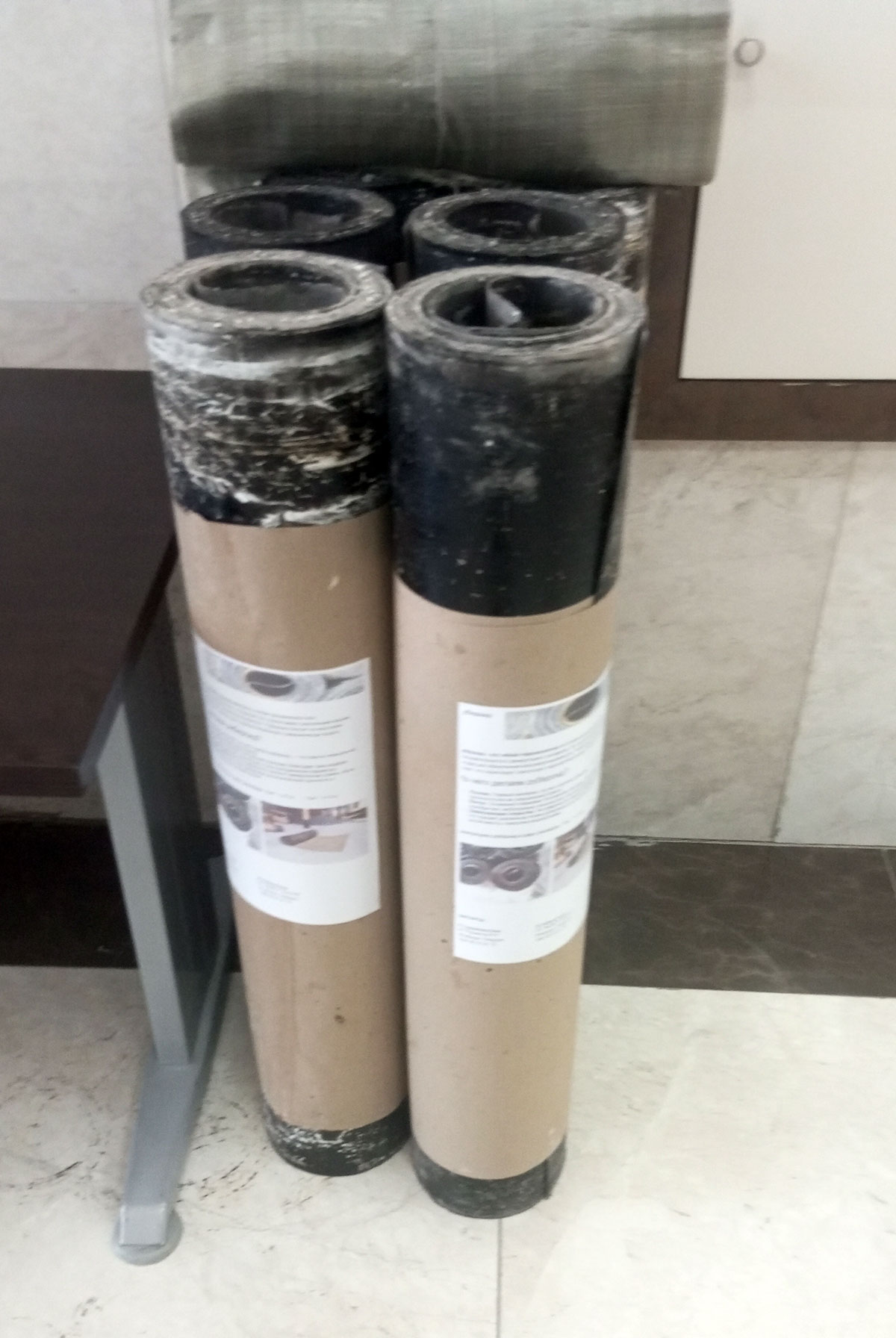
One of the most in-demand materials in the construction industry—rolled roofing felt—has begun to be produced on an industrial scale by a private enterprise headed by R. Rejepov. The enterprise is located in the Dashoguz velayat and is a member of the Union of Industrialists and Entrepreneurs of Turkmenistan. This product is widely used as a reliable waterproofing material to protect building structures from dampness, leaks, and deterioration.
At the local enterprise, roofing felt is manufactured using the following process: dense roofing cardboard is impregnated with soft petroleum bitumen, after which a layer of high-melting-point bitumen is applied to both sides and covered with a special coating to prevent the material from sticking together. A modern production line is used for this purpose. Operating in a semi-automatic mode, it provides a complete production cycle—from processing waste paper purchased from the public to manufacturing the finished product.
The production line has a capacity of between 6,000 and 10,000 rolls of roofing felt per month. Its equipment includes a special unwinding table for the base material, a bitumen mixer, an impregnation unit, a bitumen heating unit and other machinery. The enterprise purchases domestically produced bitumen through the State Commodity and Raw Materials Exchange. Around 40 people are employed at this new production facility, which is the first of its kind in the region.
As Rasuljan Rejepov, the head of the private enterprise, noted, the products manufactured there are already in demand abroad. Nevertheless, the entrepreneur’s primary goal is to supply the domestic construction market with high-quality materials.
An important advantage of the new production facility is its environmental sustainability, as waste materials are partially recycled in the manufacturing process. In addition, the enterprise has also mastered the production of polypropylene bags, which likewise involves the use of recycled raw materials.