


The Akhal-Teke horse is rightfully one of the most prominent symbols of Turkmenistan. For centuries, it has been part of the history, culture, and everyday life of the people. Its beauty, endurance, speed, and special bond with humans have made the Akhal-Teke breed famous far beyond the country’s borders.
The history of the Akhal-Teke horse is full of legends and closely connected with the ancient traditions of Turkmen horse breeding. In the harsh conditions of the deserts and foothills, horses capable of withstanding the heat, covering long distances, and maintaining their endurance were especially valued. Knowledge of their breeding was passed down from generation to generation, which enabled the unique qualities of the breed to develop.
The name of the breed is associated with the Ahal Oasis and the Teke tribe. For the Turkmen people, a horse has always been more than a means of transportation: it has been a loyal companion, a helper, and an object of special care and pride.
According to many authoritative historians and hippologists, Alexander the Great’s beloved and devoted horse, Bucephalus, was an ancestor of the Akhal-Teke horse (in ancient times, they were known as Nisean horses). Legend has it that Bucephalus was so unruly that no one could tame him. The young Alexander noticed that the horse was simply frightened by its own shadow. He turned the horse toward the sun, calmed it, and mounted it. Bucephalus traveled thousands of kilometers with the king, saved him in battles, and died of wounds in his final battle while protecting his master.
In ancient China, Akhal-Teke horses were valued as highly as gold. The emperors of the Middle Kingdom sent entire military expeditions in order to acquire these horses, which they called “hansyo” (“heavenly horses”). There was a legend that these horses produced bloody sweat when running at high speed. Scientists suggest that this visual effect was caused by their extremely thin skin and blood vessels located very close to its surface: under intense exertion, the vessels dilated, and against the background of their golden coat, the drops of sweat appeared reddish. The Chinese believed that on such a “heavenly horse,” one could literally ride all the way to the land of immortality.
Turkmen seyises (master horse trainers) raised Akhal-Teke horses in strict isolation, with the horse growing in close contact with only one person. As a result, the breed developed what is described as “swan-like loyalty”: an Akhal-Teke horse chooses one owner for life.
There are many stories of Akhal-Teke horses given to another person refusing food, becoming despondent, and allowing no one near them, demonstrating extraordinary pride. These horses are highly sensitive to insincerity and rough treatment: if a rider attempts to subdue an Akhal-Teke horse through force or harsh treatment, the horse will never submit and will do everything possible to rid itself of its abuser. But for its chosen person, this horse becomes a devoted friend, ready to go through fire and water.
The Akhal-Teke horse occupies a special place in the culture of Turkmenistan. For many generations, horses have been treated with reverence and love, seen as symbols of strength, freedom, dignity, and the pursuit of a goal. The image of the Akhal-Teke horse is reflected in literature, art, and architecture. It also occupies a central place on the State Emblem of Turkmenistan, emphasizing its importance to the country’s national history and culture.
As is known, 2026 is being held under the motto “Independent Neutral Turkmenistan – the Homeland of Purposeful Winged Horses,” which emphasizes the deep connection between modern Turkmenistan and the ancient culture of horse breeding. The symbolism of the Year of the Horse is also associated with energy, forward movement, and the pursuit of new achievements.
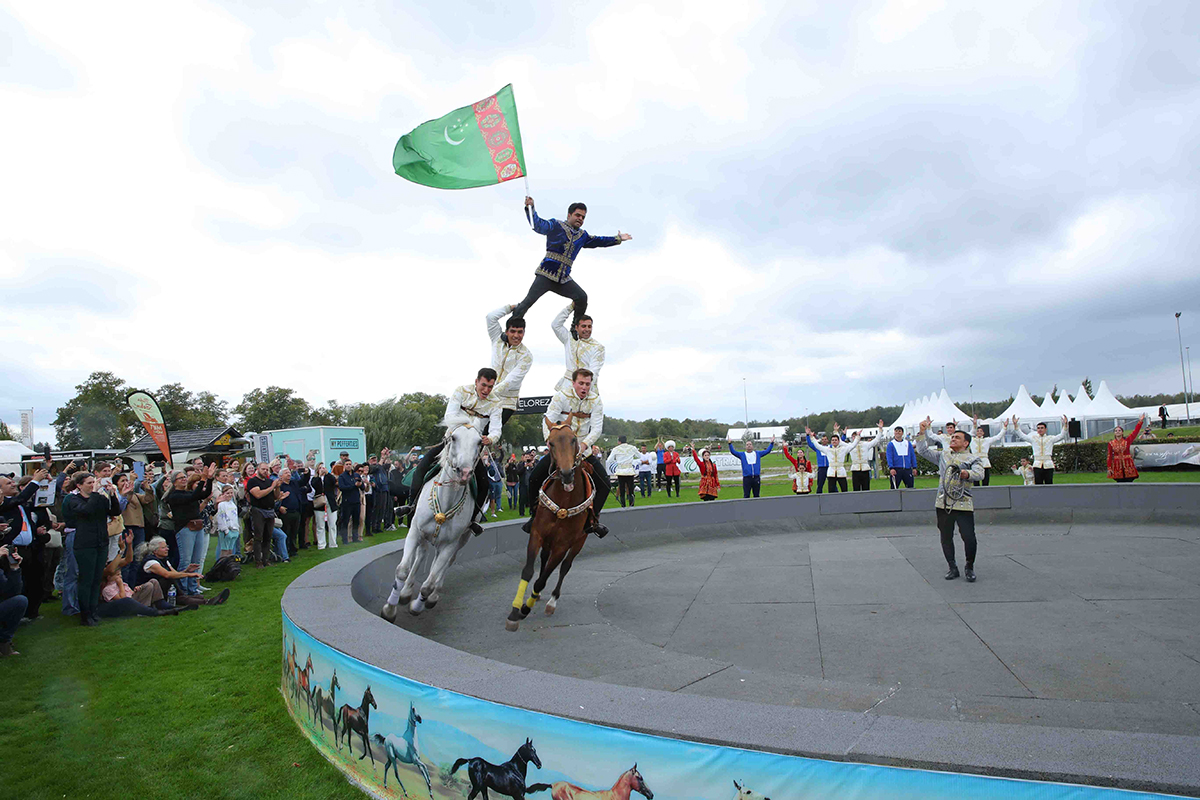
This year, equestrian competitions, exhibitions, international meetings, and scientific and cultural events dedicated to Akhal-Teke horses are being held. All of this contributes to the further popularization of this unique horse breed. A vivid example was the World Championship of Equestrian Sports and Beauty Contest among Akhal-Teke Horses held in early September at the Peelbergen Equestrian Complex (Kronenberg, Kingdom of the Netherlands). This event has historical, sporting, and cultural significance.
Holding the championship at a major European equestrian center made it possible to clearly demonstrate the exterior and functional qualities of Akhal-Teke horses to leading horse breeders, veterinarians, and athletes from around the world (more than 100 representatives of the breed from 25 countries took part in the tournament!). The art of Akhal-Teke horse breeding and the traditions of horses’ decoration have been recognized by UNESCO as intangible cultural heritage, and this tournament elevated the value of the breed to a new level internationally.
For Turkmenistan — the historical homeland of the Akhal-Teke horse — the championship also became an important platform for “cultural diplomacy.” The event strengthened international cooperation, presenting the Akhal-Teke horse not only as a national treasure but also as part of the world’s heritage.
The preservation and development of Akhal-Teke horse breeding in modern Turkmenistan is one of the important areas of state policy. President of Turkmenistan Serdar Berdimuhamedov, as well as the National Leader of the Turkmen people, Hero-Arkadag, attach particular importance to preserving the purity of the Akhal-Teke breed, developing equestrian sports, improving specialized infrastructure, and training specialists.
The country is creating all the necessary conditions for keeping and breeding horses, while national and international events are being held. Particular attention is paid to passing on the traditions of seyis (horse training) to the younger generation and expanding international cooperation.
Today, the Akhal-Teke horse has become a kind of cultural ambassador of Turkmenistan. It participates in international competitions, exhibitions, and various events, representing the centuries-old traditions of Turkmen horse-breeding art.