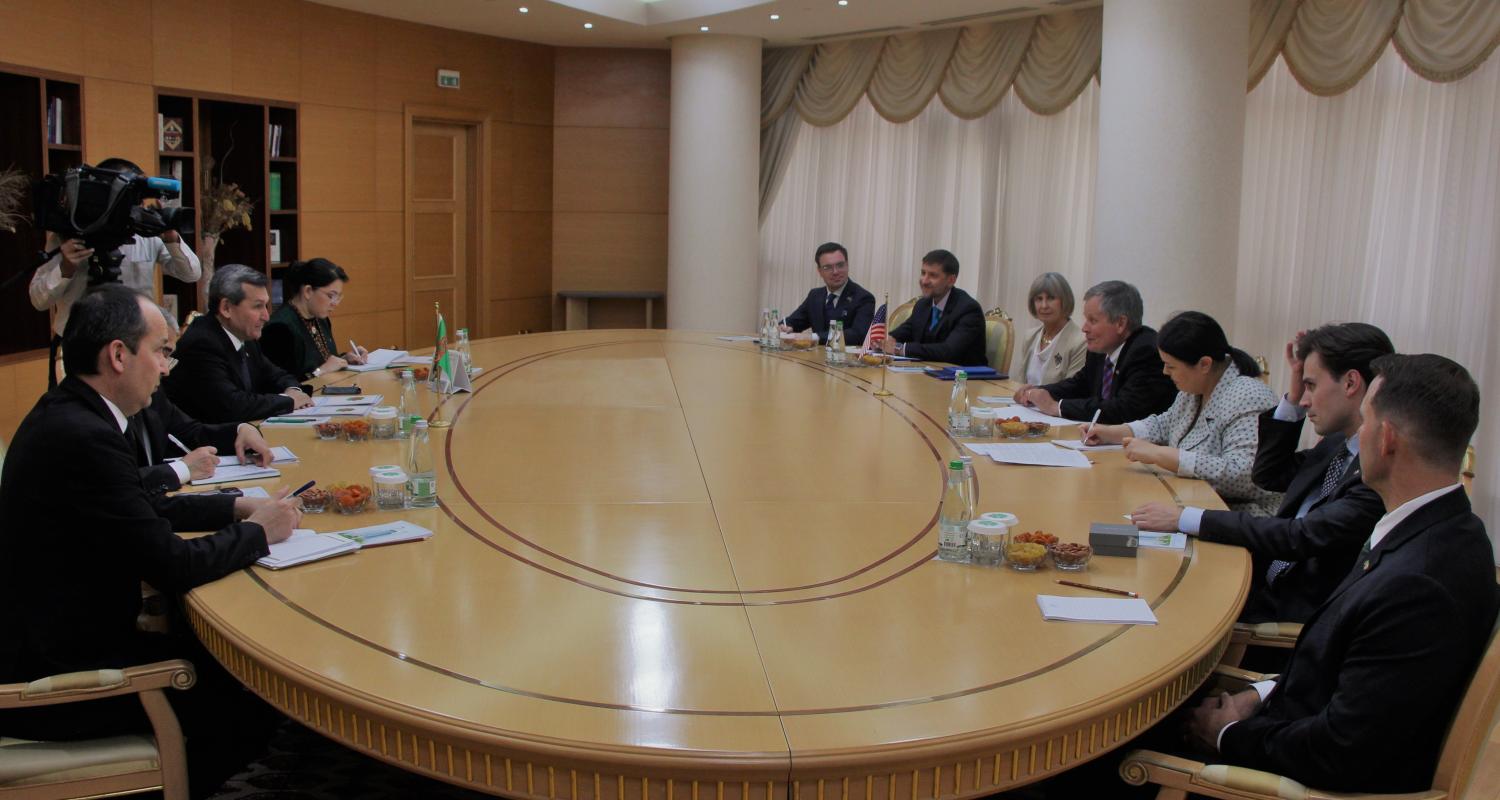



Training on "Community mobilization for the creation of water consumer groups" was held as part of the joint project of Turkmenistan and UNDP on “Addressing Climate Change Risks to the Farming Systems of Turkmenistan at national and local levels” in Ashgabat.
Supporting the efforts of the international community to find effective measures to reduce global environmental risks, Turkmenistan jointly with the UN Development Programme (UNDP) is implementing projects that contribute to minimizing the climate change effects.

President and the government of the country are paying special attention to environmental issues and the restoration of environmental systems. In all sectors of the economy are introduced environmentally sound technologies, improving the legal framework regulating the fundamentally new model of nature management. Turkmenistan has adopted a National Strategy on Climate Change. This document is a basis for the formation and implementation of state policy in the spheres of nature management and expansion of international environmental cooperation.
Realizing the complexity of the problem, President of Turkmenistan made statements on the high-level conferences in favor of closer coordination of national, regional and international mechanisms in the global efforts for the conservation and preservation of the uniqueness of our planet for present and future generations. Among the initiatives of Turkmenistan it is the establishment in collaboration with the United Nations Regional Centre for Climate Change in Central Asia. The commitment to this idea was President Gurbanguly Berdimuhamedov. He reiterated in his speech at the 70th session of the UN General Assembly, where the global program it was adopted 2030 Sustainable Development Goals.

In the context of sustainable development in Turkmenistan in collaboration with the United Nations Development Programme (UNDP) has been developed and is implementing the project 'Responding to the risks associated with climate change in the farming system at the national and local levels. "The project involves three pilot district of Karakum, Nohur and Sakarchaga. Located in different geographical areas, they represent three typical agro-ecological region of the country - mountain, desert and oasis of differing water availability and organization of agricultural production.
The project focuses on the participation of local people in environmental activities in the context of the implementation of the National Strategy of Turkmenistan on climate change implying a set of measures to improve ameliorative condition of irrigated lands, technical re-equipment of irrigation systems and the introduction of innovative technologies in land and water usage.

In the framework of the project it was analyzed of the most vulnerable parts of the measures of organization of environmental protection in the sites, the defined goals on adapting and reducing the negative impacts of climate change. In Karagum district, located in the desert area, there was a demand on traditional water saving techniques and reinforced moving sands. In the mountainous area of Nokhur region it was a set of measures aimed at the development of agriculture and vegetable production. In irrigated areas of Sakarçäge District the emphasis was made on the prevention of soils salinization and utilization of new technologies on land planning and irrigation. The project also considers comprehension of national legislation, taking into account climate change and socio-economic aspects of water management, as well as raising awareness of employees of ministries and departments, the training on lands for water users with comprehensive technology of agriculture taking into account environmental issues.

In accordance with the project in the Karakum district it is built new wells and sardob (underground tanks for the collection and storage of fresh water), to protect against sand drifts installed reed grid, designed and built by a drip irrigation system to clean takyrs. In Nohur settlement constructed and reconstructed dam, designed a new system of drip irrigation on hillsides planted juniper, laid plantations of grapes and almonds, which prevents soil erosion. In Sakarçäge District along the irrigation channels are built water-regulating device, and are being worked on cleaning of drainage collection systems, rehabilitation of soil it is introduced the land leveling method using the laser system. It is regularly, with the support of international experts organized workshops for local professionals, which opens up opportunities for sustainable socio-economic development of regions.
The priorities for adaptation to climate change areas are: health, agriculture and water resources, coastal zone of the Caspian Sea, natural ecosystems: flora, fauna, forests, soil and land resources.

Following the adopted international obligations, Turkmenistan seeks to limit emissions of greenhouse gases in the country carried out a number of effective projects aimed at improving energy efficiency, saving energy and resources. It is significant to have construction of the Turkmen lake in Karakum Desert and the state initiative to greening cities and towns of the country. It is provided and implemented comprehensive programs to preserve the unique ecosystem of the Caspian Sea, as well as to stabilize and improve the situation in the Aral Sea area. The National Strategy on Climate Change provides an environmentally balanced implementation of the mega-project on establishment of the National tourist zone "Avaza" with the usage of the latest energy-saving technologies and application of alternative energy sources.
All these measures allow minimizing negative consequences of climate change and promote sustainable economic growth.

Supporting the efforts of the international community to find effective measures to reduce global environmental risks, Turkmenistan jointly with the UN Development Programme (UNDP) is implementing projects that contribute to minimizing the climate change effects.
President and the government of the country are paying special attention to environmental issues and the restoration of environmental systems. In all sectors of the economy are introduced environmentally sound technologies, improving the legal framework regulating the fundamentally new model of nature management. Turkmenistan has adopted a National Strategy on Climate Change. This document is a basis for the formation and implementation of state policy in the spheres of nature management and expansion of international environmental cooperation.
Realizing the complexity of the problem, President of Turkmenistan made statements on the high-level conferences in favor of closer coordination of national, regional and international mechanisms in the global efforts for the conservation and preservation of the uniqueness of our planet for present and future generations. Among the initiatives of Turkmenistan it is the establishment in collaboration with the United Nations Regional Centre for Climate Change in Central Asia. The commitment to this idea was President Gurbanguly Berdimuhamedov. He reiterated in his speech at the 70th session of the UN General Assembly, where the global program it was adopted 2030 Sustainable Development Goals.
In the context of sustainable development in Turkmenistan in collaboration with the United Nations Development Programme (UNDP) has been developed and is implementing the project 'Responding to the risks associated with climate change in the farming system at the national and local levels. "The project involves three pilot district of Karakum, Nohur and Sakarchaga. Located in different geographical areas, they represent three typical agro-ecological region of the country - mountain, desert and oasis of differing water availability and organization of agricultural production.
The project focuses on the participation of local people in environmental activities in the context of the implementation of the National Strategy of Turkmenistan on climate change implying a set of measures to improve ameliorative condition of irrigated lands, technical re-equipment of irrigation systems and the introduction of innovative technologies in land and water usage.
In the framework of the project it was analyzed of the most vulnerable parts of the measures of organization of environmental protection in the sites, the defined goals on adapting and reducing the negative impacts of climate change. In Karagum district, located in the desert area, there was a demand on traditional water saving techniques and reinforced moving sands. In the mountainous area of Nokhur region it was a set of measures aimed at the development of agriculture and vegetable production. In irrigated areas of Sakarçäge District the emphasis was made on the prevention of soils salinization and utilization of new technologies on land planning and irrigation. The project also considers comprehension of national legislation, taking into account climate change and socio-economic aspects of water management, as well as raising awareness of employees of ministries and departments, the training on lands for water users with comprehensive technology of agriculture taking into account environmental issues.
In accordance with the project in the Karakum district it is built new wells and sardob (underground tanks for the collection and storage of fresh water), to protect against sand drifts installed reed grid, designed and built by a drip irrigation system to clean takyrs. In Nohur settlement constructed and reconstructed dam, designed a new system of drip irrigation on hillsides planted juniper, laid plantations of grapes and almonds, which prevents soil erosion. In Sakarçäge District along the irrigation channels are built water-regulating device, and are being worked on cleaning of drainage collection systems, rehabilitation of soil it is introduced the land leveling method using the laser system. It is regularly, with the support of international experts organized workshops for local professionals, which opens up opportunities for sustainable socio-economic development of regions.
The priorities for adaptation to climate change areas are: health, agriculture and water resources, coastal zone of the Caspian Sea, natural ecosystems: flora, fauna, forests, soil and land resources.
Following the adopted international obligations, Turkmenistan seeks to limit emissions of greenhouse gases in the country carried out a number of effective projects aimed at improving energy efficiency, saving energy and resources. It is significant to have construction of the Turkmen lake in Karakum Desert and the state initiative to greening cities and towns of the country. It is provided and implemented comprehensive programs to preserve the unique ecosystem of the Caspian Sea, as well as to stabilize and improve the situation in the Aral Sea area. The National Strategy on Climate Change provides an environmentally balanced implementation of the mega-project on establishment of the National tourist zone "Avaza" with the usage of the latest energy-saving technologies and application of alternative energy sources.
All these measures allow minimizing negative consequences of climate change and promote sustainable economic growth.