



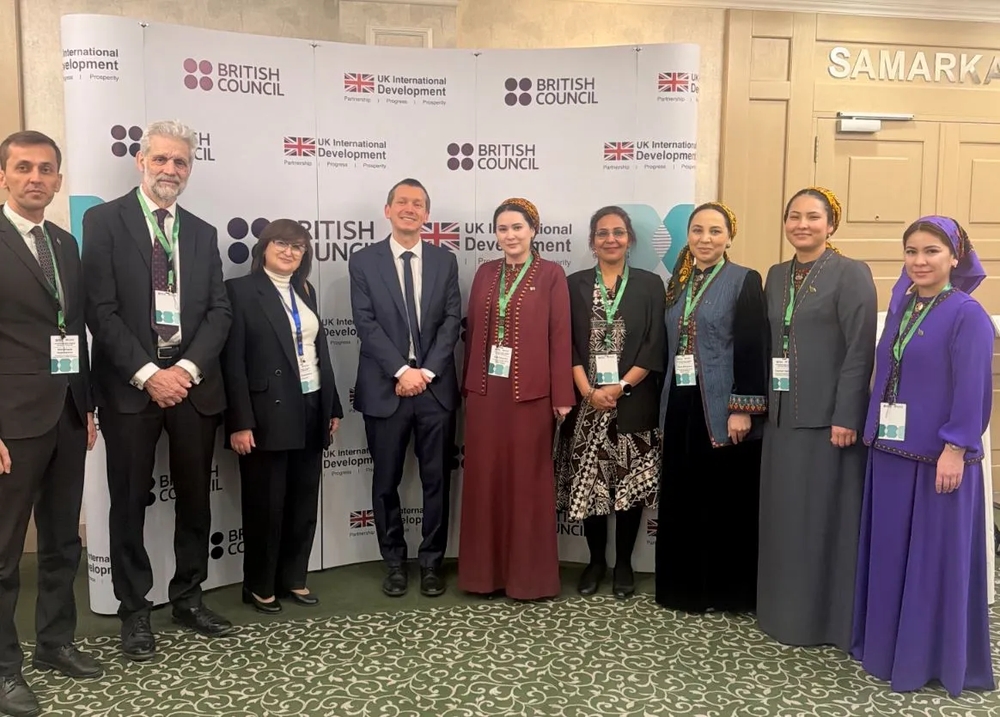
A delegation from Turkmenistan took part in the British Council Partnership Summit, held in Tashkent from March 5 to 7.
The forum was organized within the framework of the program Accelerating English Language Learning in Central Asia (AELLCA).
The summit focused on the outcomes of cooperation between 10 British and 18 Central Asian universities, as well as on the further implementation of advanced global practices within the PRESETT program for the training of English language teachers.
Turkmenistan was represented at the event by teachers and specialists from the Dovletmammet Azadi Turkmen National Institute of World Languages and the International University for the Humanities and Development.
On the sidelines of the meeting, representatives of the Dovletmammet Azadi Turkmen National Institute of World Languages presented to the international community the results of the project “Implementing Inclusive Practices in Teacher Training,” carried out by the institute jointly with Nottingham Trent University. This cooperation is primarily aimed at improving pedagogical training in Turkmenistan and fostering a more inclusive and modern educational environment.
During the summit, together with specialists from universities across the region, Turkmen delegates actively participated in specialized consultations on updating academic curricula and improving the management of educational institutions.
Participants from Turkmenistan exchanged views and experiences with colleagues from Kazakhstan and Kyrgyzstan on addressing challenges common to Central Asian countries in the field of education.
With the participation of Turkmen specialists, productive joint discussions were held within specialized group sessions focused on ensuring the sustainable improvement of teachers’ professional qualifications through Continuing Professional Development and on implementing long-term institutional changes in educational organizations.
Representatives of Turkmen universities also took an active part in a panel discussion on ensuring gender equality and inclusiveness in the region, during which ways of aligning English language teaching with international standards were also considered.
Specialists from the Dovletmammet Azadi Turkmen National Institute of World Languages presented a number of concrete proposals for further developing partnership with Nottingham Trent University within the framework of the Memorandum of Understanding between the two universities.
In particular, initiatives were proposed to expand the system of continuing professional development (CPD) for teachers, to establish a permanent Teachers’ Hub bringing together PRESETT and INSETT educators with the support of the AELLCA program, and to strengthen professional collaboration.
Additional proposals included organizing the Collaborative Online International Learning (COIL), virtual seminars and academic exchanges, developing inclusive curricula within the PRESETT teacher-training system, and conducting specialized training sessions for institute teachers on modern inclusive teaching methodologies.
The summit in Tashkent provided significant support for improving and implementing modern methods of teaching English in Turkmenistan and the region as a whole. The international event once again demonstrated the rapid development of Turkmenistan’s education system in close cooperation with leading global practices and institutions.



