


Turkmen musical culture has deep roots and is represented by two main directions: musical folklore (lullabies, labor, ritual-religious songs) and classical art of oral tradition, formed by professional singers-bakhshi and virtuoso musicians-instrumentalists (sazanda-dutar, gidzhak, tuyduk players). Their mastery, based on improvisation and knowledge of folk melodies, forms the golden fund of the Turkmen musical heritage.
Professional music of European orientation is a relatively new stage that began in the 30-40s of the last century. The formation of the Turkmen school of composers took place with the active support and participation of talented composers from other republics, such as A. Shaposhnikov, Y. Meitus, M. Ippolitov-Ivanov, A. Znosko-Borovsky, K. Korchmarev, B. Shtogarenko, M. Osokin and G. Litinsky.
The musical and ethnographic expeditions of the 1920s and 30s, organized by V. Uspensky, became a main stage. He was a pioneer in the musical interpretation of Turkmen folklore melodies. The collected material was processed by V. Belyaev, and the result of their joint work was the monograph "Turkmen Music". These recordings inspired many world composers, including G. Lobachev, A. Mosolov, A. Khachaturian, M. Ippolitov-Ivanov and S. Vasilenko.
The initial period of development of the Turkmen school of composers was a time of intensive search for unique "Turkmen" harmony, texture and rhythms. Among the first national authors were A. Kuliyev, D. Ovezov and V. Mukhatov, who in the 1930s and 1950s mastered various genres: choral and solo song, opera, ballet, cantata, oratorio, symphonic paintings and poems.
The 1960s and 1970s were marked by the emergence of young talented composers such as Ch. Nurymov, A. Agadzhikov, N. Khalmamedov, R. Allayarov, R. Redjepov, B. Khudainazarov. They were educated at prestigious conservatories and became the authors of the first Turkmen symphonies, instrumental concertos and chamber-instrumental works. During this period, the search for connections with folk music intensified and national symphonism gained independence, gradually moving away from programmatic to “pure” symphony.
By the early 1980s, the Turkmen school of composers had completed its assimilation of European genres and had formed its own traditions and unique style. A new generation of composers emerged, including graduates of the Turkmen State Institute of Arts (opened in 1972), such as O. Kurbanniyazov, S. Mukhatov, J. Kurbanklycheva, S. Tuyliev. At this time, V. Mukhatov, A. Kuliev, Ch. Nurymov and N. Khalmamedov created their best works. World giants such as Stravinsky, Bartok, Shostakovich, Khachaturian, Schnittke, Penderecki and Karayev had a great influence.
The 1970s–90s were marked by the beginning of stylistic stratification: works appeared within the framework of the academic tradition (V. Mukhatov, A. Agadzhikov) and works based on the principles of 20th century composition (S. Mukhatov, R. Allayarov, Ch. Nurymov, D. Khydyrov). Composers began to interpret folklore more deeply and go into the world of subjective feelings, looking for new forms to combine national principles of form-making with modern compositional technique.
Since the beginning of the Independence era, these trends have been actively developing. Modern Turkmen authors are looking for new musical forms and original ways of recreating the national sound, striving to synthesize modern compositional techniques with national principles of shaping and forms of oral classical tradition (aydymy bakhshi, instrumental sazy).
There is a desire to combine the sound of symphonic and chamber orchestras with national instruments. During the initial period of Independence, there was an increased interest in genres related to the word (song, ode, choral music, oratorio, cantata) in order to convey the ideas of the new society. Artists often refer to historical events and images of national heroes. In recent years, interest in purely instrumental genres has been returning.
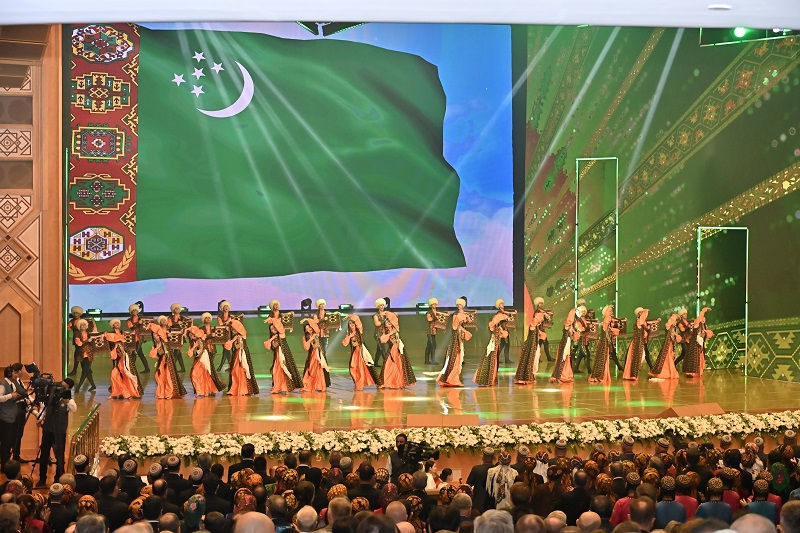
Today, the National Music and Drama Theater, the Mukam Palace, the State Symphony Orchestra, the State Choir and other collectives are active in Turkmenistan. Operas by Turkmen composers are regularly staged. Great attention is paid to the preservation and development of the national musical heritage, creative competitions are held.
The intensive formation and development of professional musical culture in Turkmenistan can be called a miracle. The Turkmen School of Composition has created works of various genres and stylistic orientations, taking its rightful place among national cultures, and continues to develop, delighting listeners with new, original works.