


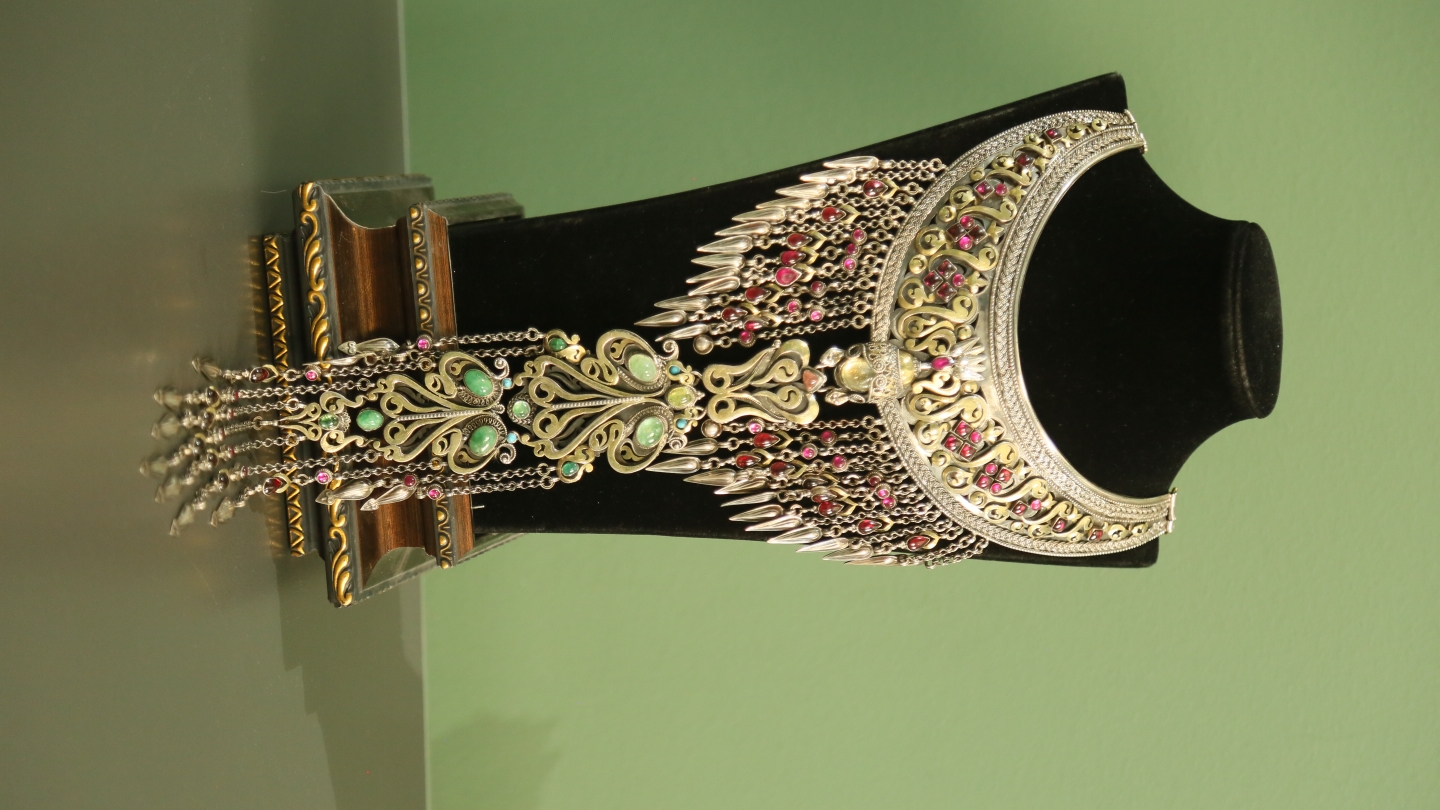
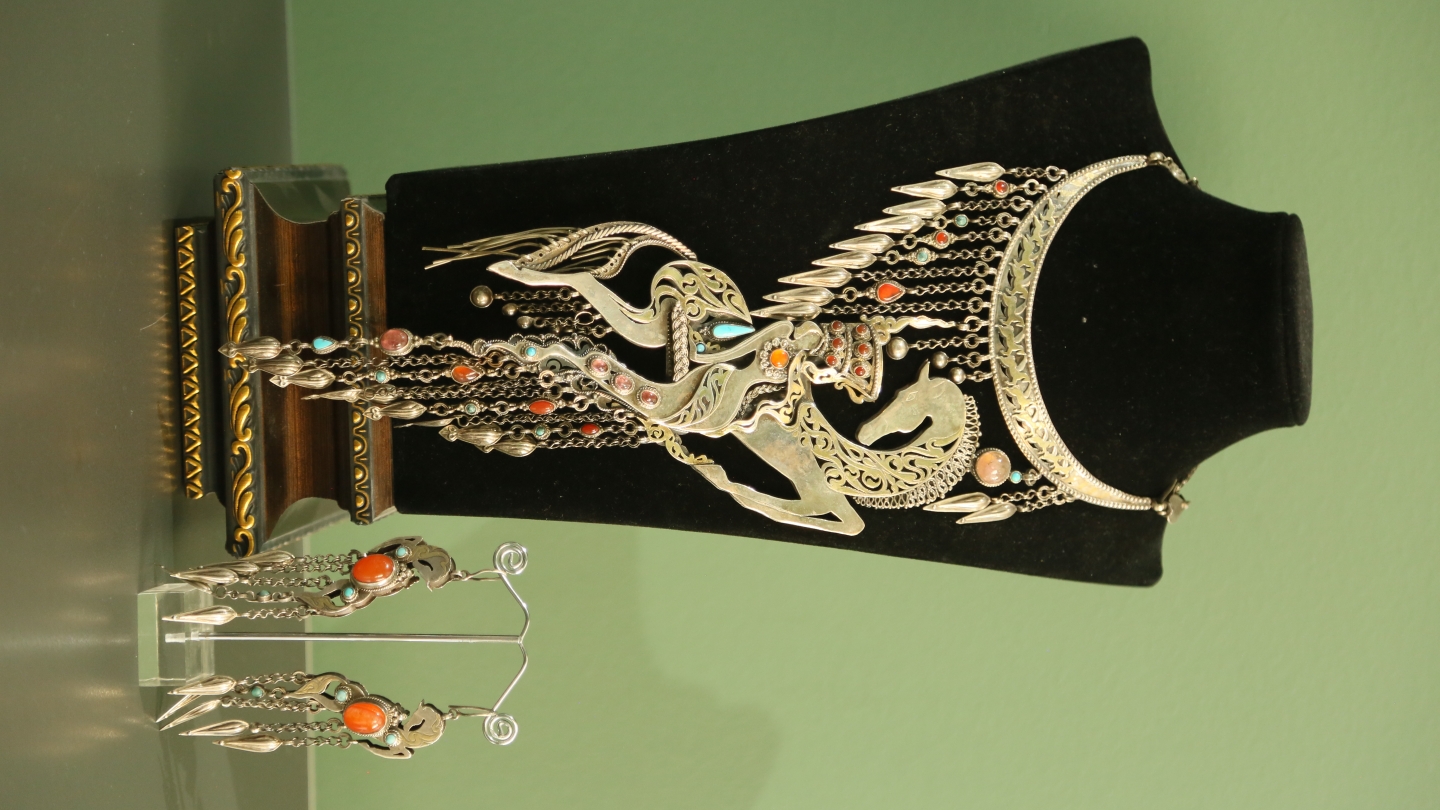

The outstanding jeweler Aijemal Charyeva was born into a creative family: her father, Danatar Charyev, was a theater artist, and her mother, Durli Charyeva, was a skilled embroiderer and gourd painting artist. Moreover, the best pastime for the girl was visiting the jewelry workshop of her uncle Amansakhat Annaberdiyev. She especially loved playing with precious stones—garnets, rubies, Indian emeralds, topazes. Sometimes her uncle gave Aijemal colorful faceted stones, which she carefully kept in a jewelry box, understanding their great value.

Aijemal graduated from the painting department of the Children's Art School named after Byashim Nurali, but when applying to the State Academy of Arts of Turkmenistan, her mother advised her to submit documents for the jeweler specialty of the faculty of decorative and applied arts.
At the entrance exams, Aijemal surprised the admissions committee with a sketch of a national gulyaka brooch featuring a firebird whose tail descended from the circle of the brooch. In her second year, she used the image of Akpamyk in a necklace; in her third year, she created a gulyaka brooch built on the legend of "40 girls," those very girls who, fleeing pursuers, turned to the mountains with a plea to take them in.

While studying at the academy, Aijemal realized she was drawn to the female theme. Over time, she noticed that she was inspired by national music, especially the unique playing style of Jepbar Hansakhedov. When Aijemal listens to his dutar, images form in her mind that seem to demand expression in a silver composition.
Characteristic features of Aijemal Charyeva's works are smooth, streamlined lines that lend lyricism to the images. Another detail by which one can certainly recognize Aijemal Charyeva's authorship is the weaving in the form of a woman's braid from silver wire. This elegant touch decorates any piece of jewelry beautifully. And, of course, the main distinctive feature of Aijemal’s works is their themes—in most of her compositions, characters from legends appear.

A particularly impressive composition is "Dayahatyn"—a legend about the construction of a caravanserai undertaken by Dayahatyn to win back her husband's love. Aijemal designed the necklace in the shape of a square, from which a woman proudly emerges, going to meet her husband. The stone adorning the necklace is carnelian. Its square shape and terracotta color recall burnt bricks. This work, like all created by Aijemal Charyeva, amazes with its sophistication.
A rich heritage from ancient zergers has been passed down to modern Turkmen jewelers. Most of it relates to wedding rituals. Jewelry in each family is passed from generation to generation. When Aijemal married, her kurte was embroidered by her mother, and the entire set of jewelry was created by the bride herself. Now Aijemal has a young daughter named Myahriban, who, like her mother in childhood, loves to sort precious stones and can effortlessly distinguish them from semi-precious ones.
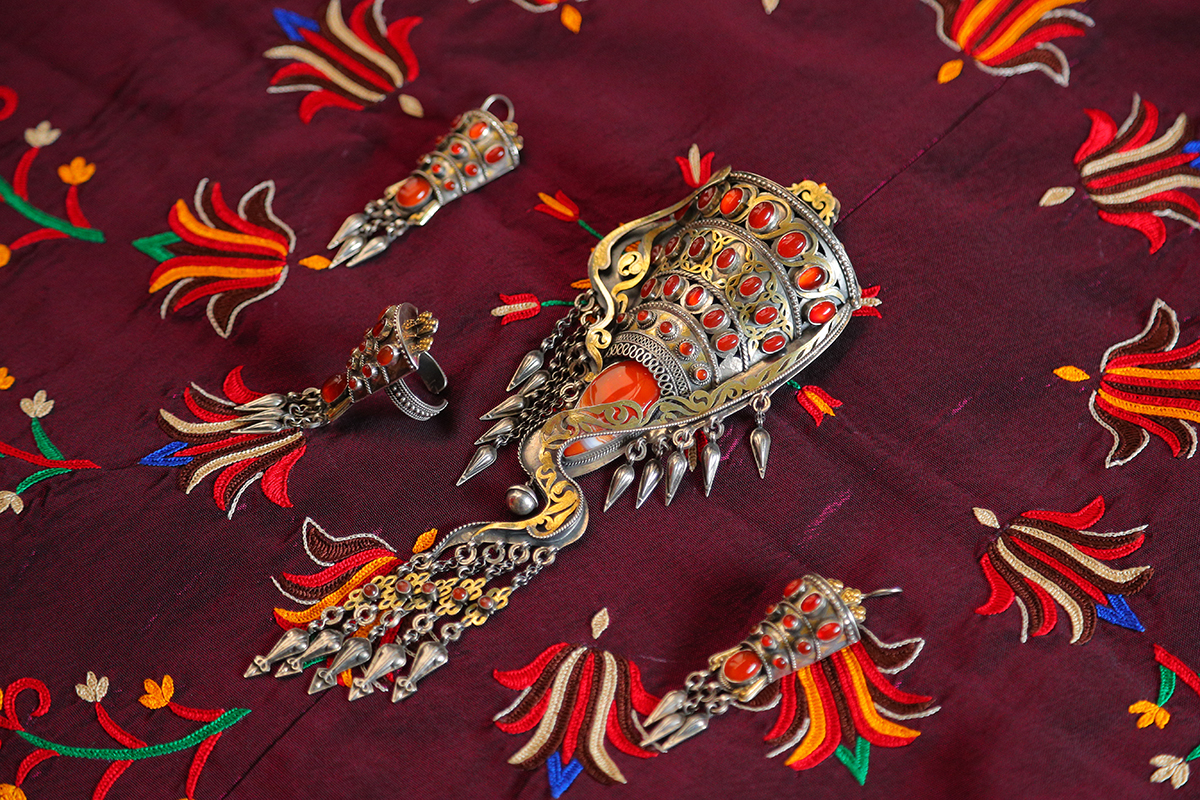
In 2013, after graduation, the talented student was offered a teaching position at the academy. Currently, Aijemal Charyeva has trained two graduating classes of jewelers. "There are very talented students," shares Aijemal Danatarovna, "especially among girls. A female jeweler is very sensitive to feminine empathy, she has more tenderness and a finer sense of thinking."
Aijemal Charyeva often exhibits her works at group exhibitions in the academy gallery and the Exhibition Center of Fine Arts of the Ministry of Culture. In 2011, Aijemal Charyeva won the competition for the President of Turkmenistan’s prize "Türkmeniň Altyn asyry". In 2016, she received the youth prize "Ýaşlar baýragy." In 2019, she was awarded a prize for horse-themed jewelry at an exhibition dedicated to the National Day of the Turkmen Horse.
Aijemal’s works are known abroad as well. In 2018, she participated in the International Forum of Young Artists of the CIS countries held in Tula, Russia. In 2019, she brought back the winner's cup from the International Festival of Handicrafts in Kokand, Uzbekistan, and in 2022 participated in the International Festival of Jewelers and Gold Embroiderers in Bukhara, Uzbekistan.
"Meetings with jewelers from other countries significantly broaden the worldview and positively influence the further growth of creativity," notes Aijemal Charyeva. "But we should not bring into our art, even very interesting elements, from other cultures. I tell my students that it is our mission to preserve the national jewelry art of the Turkmen people."